eBook
Author(s) :
Publication Date:2026-08-10
Quantity
RM 403.92
RM 475.20
The ProView registration key will be sent via email within the next 2 business days.
ISBN:
9786297851402
jurisdiction:
MY
Tagline
The authoritative commentary on Malaysia’s arbitration statute
Endorsements
“I am confident that this book, dealing with one of Malaysia’s most significant procedural statutes, will serve as a great reference for judges, practitioners and academics.”
Tun Tengku Maimun Tuan Mat | Former Chief Justice of Malaysia
“There are books one reads, and there are books one keeps within arm’s reach. For those of us who have spent any part of our judicial or professional lives engaged with arbitration in Malaysia, the writings of Datuk Professor Sundra Rajoo have long belonged to the second category.”
Tan Sri Datuk Nallini Pathmanathan | Former Judge, Federal Court of Malaysia; Fellow, Chartered Institute of Arbitrators
“To remain useful to both the Bench and the Bar, a commentary must be accurate, balanced, practical, and concise. This Second Edition succeeds in meeting those demands.”
Datuk Seri Mohd Firuz Jaffril | Judge, Court of Appeal of Malaysia
“Having reviewed this edition, we are confident that it will become a flagship contribution, consulted not merely for ready answers, but for deep insight.”
Professor Janet Walker CM, Osgoode Hall and Professor Doug Jones AO | International arbitrators; Members of the AIAC Panel of Arbitrators
“This work will become the standard reference on Malaysian arbitration for the next decade, and a useful comparative work for any practitioner working on Model Law arbitration anywhere in the world.”
Dr Rouven F. Bodenheimer | Vice-President, German Arbitration Institution (DIS)
“Professor Rajoo’s work has made the subject of arbitration in Malaysia accessible in both scope and depth.”
Chan Leng Sun SC | Senior Counsel, Supreme Court of Singapore
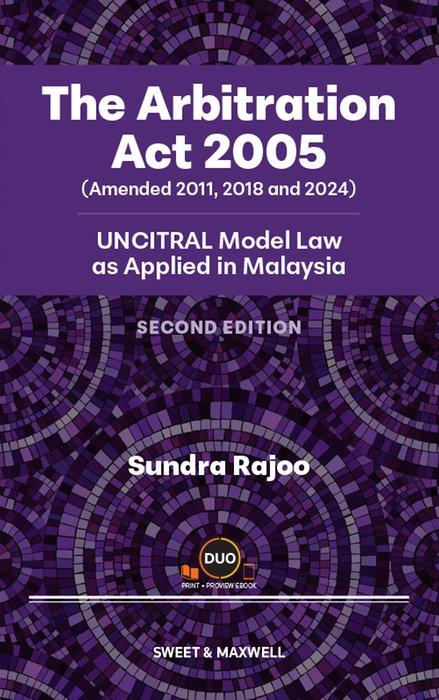
Since its enactment, the Arbitration Act 2005 has been amended four times, most recently in 2024 to introduce the new section 9A on the law applicable to an arbitration agreement, the third party funding regime in sections 46A to 46I, and the new institutional appointing-authority architecture. The Federal Court has, over two decades, given the Act its developed jurisprudential content. The Act that a practitioner reads today is materially different from the Act that was enacted 20 years ago.
This commentary is the authoritative reading. The second edition treats each provision of the Act as it now stands, sets out the legislative history of its amendments, identifies the Malaysian case law that has construed it, reads it against the UNCITRAL Model Law and the corresponding provisions in the leading Model Law jurisdictions, and notes the points on which the law is settled and those on which it continues to develop. The result is a single volume to which the Bench, the Bar, the institutional community and the academic reader can turn for the current and authoritative reading of each section of the Arbitration Act 2005.
Readers familiar with the author’s Handbook on Arbitration (Thomson Reuters, 2026) will recognise the subject matter but find a different book. Where the Handbook is organised around the life cycle of an arbitration – the agreement, the tribunal, the proceedings, the award, the courts and enforcement, this commentary is organised around the Arbitration Act itself, section by section. The two volumes are companions. The Handbook is the practitioner’s working reference when conducting an arbitration; this commentary is the practitioner’s authority on the statute that governs it. Together they give the Malaysian arbitration community a complete library on the law and practice of arbitration in this country.
Comprehensive coverage
Introductory Overview
Part I • Preliminary (ss 1–2)
Short title and commencement; interpretation; the scope and application of the Act to domestic and international arbitrations seated in Malaysia.
Part II • Arbitration (ss 3–46I)
Receipt of communications; arbitrability; arbitration agreements including the new section 9A on the law applicable to an agreement; stay of court proceedings; interim measures; composition and jurisdiction of the tribunal; conduct of proceedings; the award and its making; setting aside; recognition and enforcement; appeals on questions of law; costs and fees; third party funding under the new sections 46A to 46I; and the role of the courts at each stage.
Part III • Additional Provisions Relating to Arbitration (ss 47–51)
The additional provisions applicable to international and domestic arbitration; consolidation; determination of preliminary points of law; the powers of the court.
Part IV • Miscellaneous (ss 52–56)
Liability of arbitrators; immunity of appointing authorities; banking secrecy; bankruptcy; consequential and supplementary provisions; repeal and saving.
Format of Commentary
The commentary follows a consistent structure for each section of the Act:

Tagline
The authoritative commentary on Malaysia’s arbitration statute
Endorsements
“I am confident that this book, dealing with one of Malaysia’s most significant procedural statutes, will serve as a great reference for judges, practitioners and academics.”
Tun Tengku Maimun Tuan Mat | Former Chief Justice of Malaysia
“There are books one reads, and there are books one keeps within arm’s reach. For those of us who have spent any part of our judicial or professional lives engaged with arbitration in Malaysia, the writings of Datuk Professor Sundra Rajoo have long belonged to the second category.”
Tan Sri Datuk Nallini Pathmanathan | Former Judge, Federal Court of Malaysia; Fellow, Chartered Institute of Arbitrators
“To remain useful to both the Bench and the Bar, a commentary must be accurate, balanced, practical, and concise. This Second Edition succeeds in meeting those demands.”
Datuk Seri Mohd Firuz Jaffril | Judge, Court of Appeal of Malaysia
“Having reviewed this edition, we are confident that it will become a flagship contribution, consulted not merely for ready answers, but for deep insight.”
Professor Janet Walker CM, Osgoode Hall and Professor Doug Jones AO | International arbitrators; Members of the AIAC Panel of Arbitrators
“This work will become the standard reference on Malaysian arbitration for the next decade, and a useful comparative work for any practitioner working on Model Law arbitration anywhere in the world.”
Dr Rouven F. Bodenheimer | Vice-President, German Arbitration Institution (DIS)
“Professor Rajoo’s work has made the subject of arbitration in Malaysia accessible in both scope and depth.”
Chan Leng Sun SC | Senior Counsel, Supreme Court of Singapore
Since its enactment, the Arbitration Act 2005 has been amended four times, most recently in 2024 to introduce the new section 9A on the law applicable to an arbitration agreement, the third party funding regime in sections 46A to 46I, and the new institutional appointing-authority architecture. The Federal Court has, over two decades, given the Act its developed jurisprudential content. The Act that a practitioner reads today is materially different from the Act that was enacted 20 years ago.
This commentary is the authoritative reading. The second edition treats each provision of the Act as it now stands, sets out the legislative history of its amendments, identifies the Malaysian case law that has construed it, reads it against the UNCITRAL Model Law and the corresponding provisions in the leading Model Law jurisdictions, and notes the points on which the law is settled and those on which it continues to develop. The result is a single volume to which the Bench, the Bar, the institutional community and the academic reader can turn for the current and authoritative reading of each section of the Arbitration Act 2005.
Readers familiar with the author’s Handbook on Arbitration (Thomson Reuters, 2026) will recognise the subject matter but find a different book. Where the Handbook is organised around the life cycle of an arbitration – the agreement, the tribunal, the proceedings, the award, the courts and enforcement, this commentary is organised around the Arbitration Act itself, section by section. The two volumes are companions. The Handbook is the practitioner’s working reference when conducting an arbitration; this commentary is the practitioner’s authority on the statute that governs it. Together they give the Malaysian arbitration community a complete library on the law and practice of arbitration in this country.
Comprehensive coverage
Introductory Overview
Part I • Preliminary (ss 1–2)
Short title and commencement; interpretation; the scope and application of the Act to domestic and international arbitrations seated in Malaysia.
Part II • Arbitration (ss 3–46I)
Receipt of communications; arbitrability; arbitration agreements including the new section 9A on the law applicable to an agreement; stay of court proceedings; interim measures; composition and jurisdiction of the tribunal; conduct of proceedings; the award and its making; setting aside; recognition and enforcement; appeals on questions of law; costs and fees; third party funding under the new sections 46A to 46I; and the role of the courts at each stage.
Part III • Additional Provisions Relating to Arbitration (ss 47–51)
The additional provisions applicable to international and domestic arbitration; consolidation; determination of preliminary points of law; the powers of the court.
Part IV • Miscellaneous (ss 52–56)
Liability of arbitrators; immunity of appointing authorities; banking secrecy; bankruptcy; consequential and supplementary provisions; repeal and saving.
Format of Commentary
The commentary follows a consistent structure for each section of the Act:
Price:
RM 467.50
RM 550.00

Bullen & Leake & Jacob’s Malaysian Precedents of Pleadings, 4th Edition presents the definitive, home-grown reference for Malaysian practitioners seeking accuracy, clarity and efficiency in the drafting of pleadings. As accurate pleadings underpin every successful civil claim, this authoritative encyclopaedia delivers a comprehensive and reliable compendium of precedents designed to support the preparation of pleadings and related court documents that are both thorough and legally sound. Each topic is accompanied by clear and concise commentary setting out the applicable legal principles, together with practical guidance on pleading, enabling practitioners to draft with confidence and precision while benefitting from the extensive range of precedents provided.
The 4th Edition has been extensively updated to reflect the evolving Malaysian legal landscape, ensuring that practitioners remain current and well-equipped in modern practice. Now expanded into two volumes, its scope has been significantly broadened with the introduction of six important and increasingly relevant areas of law: Strata Management, Taxation, Land Acquisition, Digital Assets & Cryptocurrency, Constitutional Law, and Probate & Administration. In addition, recent case law has been carefully incorporated to capture current judicial thinking and developments, while the latest legislative changes have been integrated to ensure alignment with prevailing statutory and regulatory frameworks. Precedents throughout the publication have been reviewed, refined and updated wherever possible to enhance their accuracy, clarity and practical usability.
Modelled on the highly regarded UK Bullen & Leake & Jacob’s Precedents of Pleadings, this Malaysian edition has firmly established itself as the first point of reference for civil practitioners. It brings together the collective expertise of more than 50 experienced practitioners across both mainstream and specialist areas of practice, offering a depth of insight and practical guidance that is unmatched. Whether preparing a statement of claim, defence, reply, affidavit in support, consent order or any other court document, practitioners can rely on this publication for well-drafted, dependable precedents tailored to Malaysian practice.
Renowned for its comprehensive coverage, high-quality precedents and accessible commentary, the 4th Edition continues to provide a trusted and indispensable resource for legal professionals. With its expanded scope, inclusion of new case law, integration of legislative developments and enhanced precedents, it ensures that practitioners are equipped with the latest knowledge and tools necessary to draft pleadings with confidence and precision in an increasingly complex legal environment.
Key features:
Price:
RM 900.00

"Any practitioner of arbitration regularly engaged in this practice could not afford to be without a copy of this Handbook."
"If there is one book you must have on arbitration, it is undoubtedly this one."
"The same hand that built the institution now provides the literature it deserves."
"Readers will not find a mere technical guide but rather vital insight into the institutional architecture of dispute resolution itself."
"This is a composition of several books into one."
"A Handbook written with the Asian experience firmly in view is, for that reason, never parochial to its global readership."
"What distinguishes this Handbook is its ability to bridge theory and practice."
"It deserves to be read, and to be used."
Arbitration in Malaysia is no longer what it was five years ago. Virtual hearings have moved from emergency expedient to default procedure. AI-assisted document review is approaching universal adoption. Sanctions, ESG, third party funding and cryptocurrency disputes have arrived in the hearing room – often without notice. The 2024 amendments to the Arbitration Act 2005 and the new AIAC Suite of Rules 2026 have reset the procedural map. The practitioner working from a textbook printed before 2023 is already behind.
This Handbook is the answer. Across 38 chapters, it takes the practitioner through the entire arbitral life cycle – from the formation and effect of the arbitration agreement through jurisdiction, tribunal constitution, conduct of proceedings, evidence, awards, costs, and the recognition and enforcement of arbitral awards under the New York Convention. Standard topics are treated with doctrinal precision and a serious eye for working procedure.
Anchored in the Arbitration Act 2005 (as amended in 2011, 2018 and 2024) and the AIAC Suite of Rules 2026, the Handbook considers each provision against the UNCITRAL Model Law and the jurisprudence of the leading Model Law jurisdictions – Singapore, Hong Kong, Australia, Canada and England – so that the Malaysian practitioner is never working in isolation, and the comparative practitioner finds in Malaysia a fully treated jurisdiction worth attending to.
Price:
RM 530.00

“The book is well structured and organised according to the sections as they appear in the Evidence Act 1950, with relevant cases and commentaries that illustrate their application. In that respect, the book takes a very pragmatic approach to the understanding and application of the law of evidence.” –From the Foreword by Justice Collin Lawrence Sequerah, Judge of the Federal Court of Malaysia.
“In Law of Evidence: A Commentary, the author has undertaken the formidable task of dissecting the Evidence Act section by section, providing clarity that will be invaluable to practitioners and students alike. By seamlessly weaving together landmark Malaysian jurisprudence, the author has constructed a coherent and practical guide to the law as it is actually applied in our courts.” –From the Foreword by Justice Evrol Mariette Peters Judge of the Court of Appeal of Malaysia.
The mastery of the rules of evidence is indispensable in the armoury of every lawyer. This new second edition of Law of Evidence: A Commentary marks a significant leap from the original 2020 edition with fully updated and expanded commentary on the Evidence Act 1950.
The principles of law developed through cases over the years, both local and foreign, are skillfully distilled and succinctly summarised for the easy guidance of readers. The decisions of the Indian courts which are important for a better understanding of evidence law have been carefully considered and discussed. Instructive cross-references guide users through the intricacies of the working of the Malaysian law of evidence.
For legal professionals and students alike, this updated version is invaluable, bridging the gap between fundamental evidence rules and Malaysia’s rapidly modernising judicial landscape.
Key features:
Key developments covered in this new edition
Price:
RM 550.00

